Thursday, April 28, 2011

Social Criticism: Depression and the Insanity of Government Drug Dealers


I hear a lot of talk nowadays about depression. I actually hear more about antidepressants than the actual depression. I keep hearing about how depression is a "disease", and that it "hurts". Not that these things aren't true, but in the grand scheme of existence and our alignment with mother nature, is depression real?


Travel back in time to the year 1860. Abe Lincoln is elected president, and the Civil War hasn't even started yet. Things are good. Things are simple. People build their own houses. People grow their own food. People hand wash their own clothes. People make their own clothes. Aside from the war, what could people back then possibly be depressed about? Losing at love? A death in the family? Well, yes, definitely. It pretty much ends there, though.


Now, it's the year 2011. Now let's consider what there is to be depressed about nowadays: war? Money? Health care? Nope; none of these things. I have a firm idea, that most of the people suffering from depression nowadays are the victims of decaying self-image brought on by the media. It's all about TV now, and it's all about other people. Every person on television is either happy and living the dream, or handsome/beautiful and on top of the world.


Alternatively, most of the shows on television focus on the pathetic folk; people we can look down on and point our fingers at. Nowadays, folks get depressed because they can't have love/sex right away, or they can't find it within them selves to contribute to society, or because they look at the TV and even in the world around them and find themselves in a "lower place", or "worse off" than others.


Advertisements for antidepressants claim that "you don't know why you feel down, but you just do, and it hurts", and that these "victims" should take their medication to help them live a happy life.


What, and not deal with life at hand? Take drugs?


I can count on two hands the people in my small, close circle of family/friends that take antidepressants. And you know what? They're completely different people. It's the worst when they first go on the meds; a permanent smile stuck on their face, their eyes glossed over and laughing at the stupidest things. It's sickening to me, because I'm aware that these people have more than enough power to look their depression in the face, and see what it can teach them.


That's all depression is in my eyes; a learning experience. Acknowledging your depression is better than suppressing it with drugs (drugs synthesized by the government, mind you), and I just think a lot of people don't even think to do simple things because they're either so distracted by their depression, or they're already suppressed under medication. Go for a walk; draw a picture; write down your thoughts; smoke marijuana; clean your room, organize your files, etc, etc... Most people with depression don't even give these activities the time of day.


We all get depressed. However, I think it's important not to give in to what the government says is "serious", or "a disease", and just sit around in a corner like people used to, and cry it out. Your mind has enough ability to sort things out for you, even if it takes months upon months.


Take your depression to the face. Because otherwise, your just letting the government turn you into a drug addict. Depression can be a good thing and eventually, for some people, what you were once depressed about, actually gets suppressed or "blocked-out" by the depression. Depression is not a disease, but it does hurt. No pain, no gain, though; and this is definitely something that people of today have largely forgotten.

Sunday, April 17, 2011

Driving in Massachusetts


Anytime I get into my car, I'm trying to get to where I'm going. Makes sense, right?

So I drive a little fast. It's not a dangerous fast, barely even an illegal fast; maybe five to seven MPH over the speed limit. I comply to the speed limit for city/town driving when someone is in front of me, but if no one is in front of me, I'm cruising.

Highway traveling, is a different issue altogether. The highway has multiple lanes, so fast drivers can pass the slow drivers. But when the slow driver is in the left lane, driving neck and neck with the car in front of you in the right lane, and you're trying to pass, it evokes anger and madness. Why won't they just pull ahead of the car and get back in the right lane like a good driver does? Some people are late for work. Some people are in a rush to get somewhere, and these horrible drivers just get in the way.

If you see a car in your rearview coming up fast on you in your lane, GET OVER TO THE OTHER LANE. Is this so terribly hard to understand? When there are other cars on the highway traveling faster than you, make way for the fast drivers.

Another facet that really bugs me about Mass drivers is the inability to stop before taking a turn off of a street. They think, "Oh, maybe this time no cars will be coming, so I can just pull out onto the main road without stopping!" So they get caught up when they see me coming, and they're halfway out onto the main road, so I have to put on my brakes and let them go, because they're in my way. This is totally unacceptable, and completely dangerous. I may be a fast driver, but I don't just pull out onto a main road without stopping; that's absurd.

And the real clincher out there on the road, is that OLD PEOPLE SHOULD NOT DRIVE. There should be an age, say 70, where it's illegal to drive. Just like it's illegal for you to drive at age 15, I think there should be a cut off when you get to be elderly. Between depleted motor skills, tired vision and hearing, and caution bringing speeds down to 10 in the city and 45 on the highway, they just shouldn't be driving. If it were illegal for them to drive, and they needed to get somewhere, a taxi is just one phone call away, and it's not like old people have no money; they're assisted by the government; they can afford a taxi. It's basically old people not willing to accept their dependence on others, and it just brings danger to the road.

Next, let me just elaborate on how many pickup trucks I see out there driving everyday. NOTE TO THE PEOPLE: YOU ARE WASTING SO MUCH MONEY. I don't care if you're a brain surgeon and you make $250,000 per year; you're wasting money. Doesn't it make you sick that a gallon of gas gets you 13 miles? Did it ever occur to you to buy a hybrid or, gee let's see, a regular automobile? A lot of these truck drivers aren't even hauling stuff around; they simply enjoy being up high on the highway and having bullshit to talk about with the other truck guys (how big the engine is, how much gas it eats, useless aftermarket additions, and so forth). It's so uneconomical, and it's going to drive these people personally into the ground, along with the United States. So, it just makes me cringe to watch these people waste so much money on unnecessary forms of transportation.

Driving in Massachusetts is not a privilege in the least sense. I think that driving should be a privilege and not just a means of getting us to work, or to the market. I mean, when you really think about it, why would you work somewhere that's an hour-and-a-half away from where you live? Just because you got the job, now you're going to commute and blow your salary away on gas? Use your fucking head.

Stop driving automobiles and walk the countryside.

Friday, April 15, 2011

Typewriter

Today I sat atop a mountain top with my typewriter and I thought of you I thought of you, and times of blue and a hazy, crimson hue Yesterday I walked from Oak St to Main with my typewriter I was reminded of you I was reminded of what you said to me Leave Leave Leave Tonight I'm going to the top of Stony Hill with my typewriter Try to spew out wordly words Try to spew out wordly words and listen to my Northern birds go Cya, cya, cya Tomorrow I'll write you a letter with my typewriter And I'll spew you a stanza I'll spew you a stanza of heartache and pain Analog gain, gain, gain Right now I wish I was with my typewriter

When there is nothing you can do, just write

Today there is nothing; there is nothing because every time i hit the D key, I have to realllly hit the D key which doesn't lead itself to the spontaneous writer; nor does this entire keyboard, actually. Typewriter. Oh, typewriter...

Thursday, March 3, 2011

Social Criticism: Unappreciation for the Fellow Performing Artist


I find it somewhat strange that people don't look at the performers anymore.


I walk into this bar, converted from a car garage, to come see my lady friend play her geetar and howl over the African drum; 'twas a nice even mix, although my friend's voice should've been mixed louder.

I've sat down in a booth with aquaintances, sipping my S. Adams and keeping a keen eye on the lady singer, who sang so well I kept thinking about how her microphone should be louder. I look to my left, and there's a man, a young man, head stooped over in a beanie on his seat, face illuminated by a Blackberry; I look to my right, and a woman is smiling at me; I turn around, and I see my lady-friend-guitar-player; and I ask myself, and others not aloud, "Are you not anamored with the music? This woman singing? This djembe rumbling the floor?"

Has music just become a background noise to you? A mere pulse in your juvenile pursuits? Where have days gone, when music held water to your emotions? Has music become mere riffs, or crescendos into compressed bass drops and vocal samples? To you? Has it?

She sang a song so sweet, and had but two on their feet; but the hum of the jock is too hard to beat; nobody listens, might as well repeat; slip a little sauce in these guys with their peats; bring a little more smile to the street...a little more smile to the street...

Next time you are entertained, shake your ass and have no shame; appreciate the troubadour who lit your flame, and dance the stars 'till light; it is he with the bamboo flute that shake you out yo' suit, so come on in and close the door behind ya

Evening for my star

Wednesday, February 9, 2011

The Future of Music


"Pretty Lights is the future of music!"


...says one of my Facebook friends.


As far as Pretty Lights goes, it's damn fine music if I'm on a long car drive, or if I have to get some work done; it's ambient music to me, and as a musician, I can't agree with my half-there buddy who thinks this lame recycled-hoo-lah is the "future of music"; that's not possible.


Why? Because there will always be real musicians; people who speak through an instrument. People like this in large groups, of maybe 4 or even 28, will affect human beings more than a 4-bit version of a James Brown rhythm-section break; samples make sample-based music.


Even if it's not sample-based music, Pretty Lights is catering to a state of mind. The Grateful Dead used to do that fifty years ago, during a time similar to this where it needed consciousness-change the most. But what pisses me off about today, is that these Pretty Lights cats are catering to Mollyed-out disco biscuits; knuckleheads just floating on Ecstacy and following a trancy and acidicly poisonous beat; it's not music; it's instant gratification.


You know the beat, so you want to hear it; you know the stupid spacey, trancy sounds and the cheese-factory-sounding vocals; you've heard it before, and what you find familiar is the foundation of what you seek. However: human beings have since forgetten that upon hearing something completely unique for the first time (The Beatles, Nirvana, Eminem, Phish, The White Stripes), our state-of-being moves forward a step, and reconnects with things we do know, but things we didn't think we knew.


Lost you yet?


All you have to remember, is that if you're going to be a golden and appreciative listener, you should be looking for the new rhythm. All the rhythms on today's mainstream radio are all from House music and has sort of a Latin flavor; these aren't new ideas.


Realize that reggae was created out of thin air, just by taking the conventional downbeat out; one beat. Just one beat, and reggae was born. The drummer stopped hitting the kick-drum on the "one", and started playing it with the snare on the "two". By filling the empty spaces with chicka, chickas, reggae was born.


Music begins with rhythm, and in more complex terms, vibrations. This is all music. All music is vibration. Rhythm is the basis of everything. If a drummer to a rock n' roll band doesn't realize that it is HE who drives the band; he is at the foot of a long and steep path to finding out that truth for himself. New types of music will derive from new rhythms.


Just like new change will be brought on by social movement, music will take a new direction, and in an organic, real fashion, just as it always has. Because there are some artists out there, some of whom you've never heard, who know how to create something new and fresh that will crush and crumble anything you ever thought about Pretty Lights. Pretty Lights is nothing but a bunch of pretty lights; they're a crazy poster to look at when your on drugs; an enhancement to your detachment from reality.


Reality is here, and it's now, and it kind of sucks. What are you doing about it? Getting high on Molly?


Figure it out.

Tuesday, January 25, 2011

The "Lone" Musician


I find it interesting that two musical parts can be less intimate than one, but more uninhibiting also. With two musical parts, things become relaxed and festive. A man's voice and his guitar: festive. Two horn players: festive. Guitar and banjo: festive.

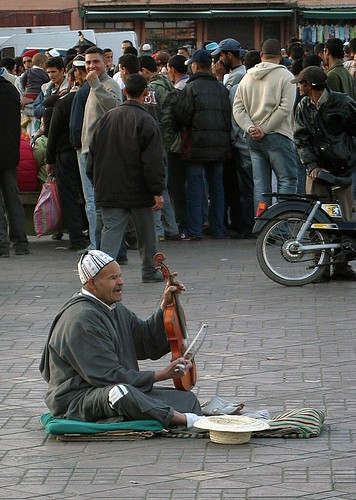
The lone musical part however, the solitary expression, is the purest, and shares the most intimacy with it's listeners, for there are only listeners. A lone alto sax blower, running scales over some band in his head: intimate. The deep and rhythmic throngs of the lone African djembe: intimate. A person reading poetry among silence: intimate.
How then, does the solitary musician keep our interest?
The lone sax player's note selection suggests at an imaginary (yet, existing) underlying part, that not only he hears, but he who listens hears. After a while, it appears that something else is there.

The rhythmic throngs of the djembe are polyrhythms, found on and utilized by multiple parts of the drum; an orchestra of rhythmic tones needing nothing except organization; again, suggestive to space, and filling space.

The poet is not just speaking for himself; he speaks for nature and for the imagination; for when the poet speaks, we listen, but when he rests, we examine mental images and internal feeling based on words he has said.

The verdict here, is that "lone" musicians are never alone. There's something there anchoring the function and inspiration of the single instrument, whether we see it our not. Whether it be something we see like the sax player's foot tapping along, or something we don't see like the sax player's thoughts of clouds as he plays the Reinhardt classic, "Nuages"; humans still understand it, and it's very different from the group configuration.

In a group configuaration, many things change. You have to assume that while he plays, the lone musican must be filling as much space as possible, even if using silence. An acoustic guitar player does not play a single-note, single-string melody by himself, but rather he strums a three, four, five, or even six-string/note chord; a chord with six parts ringing through at once. Some acoustic guitarists that combine rhythm and lead parts, and an example of that kind of player is Joe Pass.
What Pass did was play all the basic parts of a jazz ensemble band on the guitar. That means, his thumb often caught the bass line (as well as high-string melodies), while his index and ring fingers provided chordal accents, as well as some brilliant "in-between" lead lines. He often did this entirely by himself with no accompaniment, and produced a whole album of songs in this manner.

Joe Pass's thumbed basslines held everything together (even when not playing), and he provided eighth-note, triplet-chord accents in between his chromatic lead playing; a simple, yet delicious recipe. It's the pulse and walk of the bassline, the harmony of the piano, the volume accents and syncopation of the drums, and the dramatic, improvised soloing of a horn, all on electric guitar.

These are dramatic shifts of rhythm on his part, and it's all suggestive. That's what the solo, lone musician ultimately is: suggestive. This involves more solitary imagination than the mutual imagination of a musical group. Solitary imagination is a deeper, more potent form of imagination, and it affects people more powerfully.

The lone musician teaches us that power and deep emotion doesn't have to involve hundreds in unison chanting, a multilayered orchestra, a harmonized chorus, or a rock & roll band, but that it also exists on the solitary end, where there is space to be taken up by it's listeners.

Henry David Thoreau favored the sound of a solitary music, flute specifically, and that was much like how he felt about life. But perhaps this is when we ask: Music, Life, what is the difference?